2021年2月28日星期日
relaxing time
2021年2月27日星期六
2021 Febuary in chaozhou
We spent the whole month in Chaozhou in February 2021. We will be in Chaozhou every January of the lunar calendar since we got married in 2013. My husband Zhou Shiwu is from Chaozhou, Guangdong Province. He lives and works in Wuyishan with my family all year round. But no matter how busy we are, we must go back to his hometown to celebrate with his family during the Chinese New Year. This is a tradition in the bones of Chaozhou people. I respect it very much. When I have my own child, I I also support this behavior of my husband even more.
Chaozhou is a very interesting place, where there are very delicious food, traditional customs, strong clan spirit, and of course Kung Fu tea available in every household. It is a place that makes me feel a strong human touch. I am very fortunate and grateful that I have a relationship with this city.
(The third day of the first month ,relatives have dinner at my husband's house)
After the meal, the entire clan gathers in the Zhou clan's ancestral hall. The more prestigious members of the clan will speak and make a statement about the good or bad things that happened in the clan in the past year. Then the older generation will spontaneously sing Chaozhou opera.
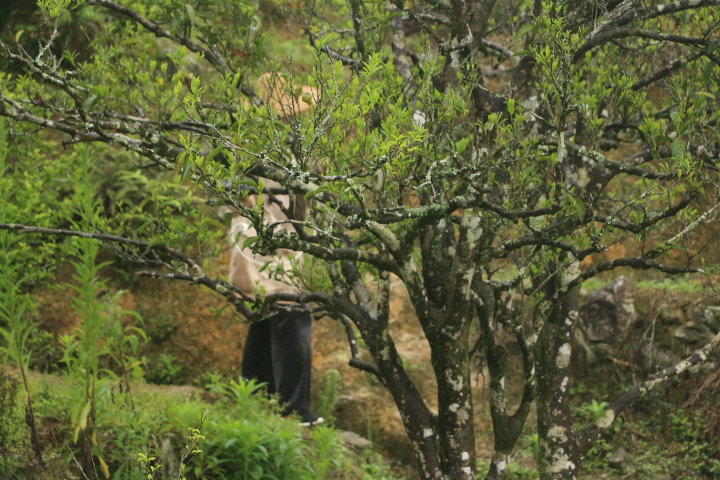
We are very busy in February 2021. Since April 2019, my father-in-law has signed a lease contract with the government. We have a 50-year use right for a tea mountain. Then, starting in 2019, he will start to open the mountain and build roads. Finally, in 2020, at the end of the year, we planted the first batch of saplings brought over from Wuyi Mountain, as well as some more popular varieties in Chaozhou. This will be our organic tea base. We don’t know what will happen in the future, but I told you My husband is very happy, just to give this beautiful world a little bit more green.
(my new garden with wuyi cutlviar in chaozhou )
2020年4月29日星期三
Wuyi oolong processing
Wuyi rock tea is usually picked in the middle of April. Wuyi rock tea is picked according to the standard of three leaves. Pick up the tea plants as soon as possible after picking, to prevent the tea leaves from excessive extrusion and burning.
2:
in wuyi we call this step as 倒青(dao qing )or 晒青(Shai qing)
Wuyi rock tea Withering is a metaphor for the green leaves are suntanned after the tea part of the top lying down or soft. Before withering is to spread the fresh leaves on the bamboo basket .In order to better disperse the tea, it is now replaced by big cloth or net . Whether it is appropriate to wither has a lot to do with the follow-up processing . The technology of withering is the basis of forming wuyiyan tea's fragrance and taste. Withering can rapidly increase leaf temperature, evaporate water, enhance enzyme activity, promote decomposition and transformation of macromolecule compounds and destroy chlorophyll, which has a good effect on aroma formation.
withering always happen before 11 a.m. and after 2 p.m. and the whole process of withering needs to be turned 2-3 times. The time of withering depends on the condition of tea and the intensity of light (generally about several minutes). When the temperature is too high, we should pay special attention to the change of green leaves , in case the temperature is too high to burn the leaves.)
When to stop the withering , it usually depends on whether the top leaves and sharp buds are drooping and most of the leaves are tarnished. It can also be judged by the feeling of grasping the leaves by hands and whether the withering meets the requirements. The leaves are soft, the green air is decreased, the green fragrance is exposed, the weight loss rate is 10% - 15%, and the water content of the leaves suitable for the sun is about 70%.
Zuo qing is carried out alternately by shaking and standing fermentation. Zuo qing indoor temperature control in 24-30 degrees, humidity control in 80% - 85%. The Zuo qing stage is the key link for Wuyi rock tea to express its excellent endoplasm, form good color, fragrance, taste and "green leaves and red edge".
About Jin junmei processing
Jin junmei and lapsang souchong from Tong muguan (Village), Wuyishan National Nature Reserve, and belong to the category of black tea. Anyone who knows something about tea knows tongmuguan, the birthplace of the world's black tea.
Jinjunmei is not a traditional black tea. It was only created in 2005. It is made of pure bud head. Only 60000 to 80000 bud tips can be made into jinjinjunmei. At present, there are few Jin junmei in Tongmuguan, and the price is very high.
In terms of harvesting time, due to the high altitude (over 1000m) and low temperature of tongmuguan, the first wave of harvesting time of Jinjunmei every year is basically after Qingming Festival, probably after the middle of April, so Jinjunmei has no so-called "tea before the Ming Dynasty".
How is Jin Junmei refined?
Step 1: picking. The picking standard of Jinjunmei tea is that the leaf tip is more mature than red and green tea. Jin Junmei requires to take fresh tea buds and pick the most tender part of the bud head, which requires very high picking skills. Because of the high altitude of tongmuguan, the slow growth of tea trees, and no chemical fertilizer and pesticide, the black tea here is only picked one season a year, and the yield of golden eyebrow made from pure bud tip is less.
Step 2: pick and choose. Many people think that the fresh leaves picked can be dried and withered. In fact, there is a process of sorting. When we pick the new tea buds ,there will be some old leaves outside .So the tea was picked and arrived home .We have a sorting step .We call this as “peel the buds ” . Its purpose is to guarantee that the raw materials of Junmei are all bud tips.
the leaves from garden :
Step 3: Withering . Spread the tea evenly in the basket .The withering of Golden eyebrows can be divided into indoor withering and sunlight withering. Now, due to the weather, it is often impossible to do the sun withering. Most of the golden eyebrows made in one day are withered in the indoor withering machine. This process takes about 3 to 4 hours, and the amount of water lost in this process is about 70%.
Step 4: Rolling . using the hands to do the rolling step ,to set the shape and roll the leaves into strips. (now more machine rolling instead of hands working )
Step 5: fermentation. The purpose of stacking the rolled tea leaves together and covering them with wet cloth is to destroy the cells on the leaf margin, thus promoting the enzymatic oxidation and making a series of biochemical changes in the fresh leaves. The process takes about 7 to 8 hours, and the fermented tea turns red.
Step 6: dry. Put the fermented tea into the baking machine, bake slowly with a gentle fire of about 90 ℃, and dry all the tea in about 3 hours, and the authentic Jin Junmei will be refined!
2020年4月14日星期二
Lapsang souchong processing
Tong muguan Village, Wuyi Mountain, Fujian. Tongmuguan is located in the northern section of the Wuyi Mountains, with a high altitude, 1000-1500 meters above sea level, warm in winter and cool in summer, with an average annual temperature of 18 ℃ and annual rainfall of about 2,000 mm. Between spring and summer, the clouds are foggy all day and the sunshine is shorter. The frost period is longer, the soil moisture is sufficient, fertile and loose, and the content of organic matter is high. , Deepen the soil layer, so the tea is lush, the leaves are thick and soft.
At present, my family's Lapsang souchong is divided into smoked ones and unsmoked ones:
Smoked style and unsmoked style are distinguished based on whether they are smoked with pine needles or pine wood in the production process: those smoked with pine needles or pine wood are called "Smoked Lapsang souchong"; no pine needles or pine wood are used Smoked, it is called "Unsmoked Lapsang souchong ". The tea produced by these two different production processes of Lapsang souchong has obvious differences. Everyone also habitually calls smoked style as traditional craft , and unsmoked new craft .
The production process of unsmoked Lapsangsouchong :
1:fresh leaves Picking:
the picking standard of the Lapsang souchong ,2leaves with one buds ,all the leaves are quite tender and fresh at the beginning of April .
2:Withering :
Fresh leaves just picked
Withered leaves (after 8hours )
4: Fermentation: (in this step is about 5-7 hours depending on which cultivars and
the temperature)
After fermentation ,the tea leaves is quite wet ,so we use this machine to dry the tea .For the lapsang souchong noramlly it is 85-95degree and around 3-4hours .In fact this step is just for basically drying , after this step , we call this tea as Lapsang souchong Maocha .
5:Mao Cha sorting : pick out the tea stems and Huang pian (old and big leaves )
6:Roasting :
Most of local tea growers still use the electrical machine to roast ,
but also some tea growers use the charcoal fire to do the roasting .
in this step normally it is about 4-6 hours and with the temperature 90-105C
7:Package into box:
package the tea into boxes
2020年3月31日星期二
2020,Spring tea harvest .
This year, my family start the picking on March 18th. The earliest variety picked in Fenghuang Mountain was the white leaf(Bai ye白叶)(also known as the Mi Lanxiang ). This variety is an early-ripped species, and it is normally harvested before Qingming (April 5th).
Recently I received several emails from teafriends asking questions about new tea. I want to explain something accoring cognition.
1: Many people believe that the earlier the quality of spring tea picked, the better. Actually not. To be precise, it should be that the quality of the head spring tea is good. This is because the tea tree has taken a rest in winter, and the roots buried deep in the soil absorb enough nutrients, making the tea buds germinated in spring and rich in nutrients such as vitamins. The aroma is strong, the taste is fresh, and the changes are rich. And tea trees in spring are generally free of pests and diseases, so the quality of tea picked in the first spring is often the best in a year. As long as it is picked in the first wave of spring, it is considered spring tea, which is not to say that the sooner it is picked, the better. On the contrary, if you pick it prematurely, the sprouts of the tea are not fully developed, and the effective nutrients are not accumulated enough. The tea produced is not only light in aroma, but also astringent, light, and not resistant to foaming,I think.
2017年10月11日星期三
How to evaluate a cup of tea
Appearance: Cleanliness , uniformity :
when you get the tea ,checking the dry leaves if it is clean ( if still have the huang pian or tea stem left , normally tea sorted by hands is much cleaner than the machine sorting ) ,and all the leaves are uniform or broken
a well- processed tea always with very golden color soup ,and it is very clear ,and the soup is very bright .